
Rajaji National Park Safari
The forest where the Ganga leaves the mountains, home to leopards, wild elephants, and a tiger population being brought back to the western hills.
Safari Timings
Rajaji opens from mid-November to mid-June and closes through the monsoon, when the raus run full and the forest renews. Winter mornings are cold and often misty, worth every layer for the light alone, while the dry heat of April and May concentrates wildlife along the Ganga and the remaining water. Morning and afternoon jeep safaris run daily in season, with timings set by the forest department; confirm the current schedule when booking. Haridwar and Dehradun both sit about ninety minutes away, making Rajaji the most accessible true wilderness in northern India.
Rajaji
Stretched across the Shivalik foothills of Uttarakhand, where the Ganga breaks out of the mountains and into the plains, Rajaji is the forest most travellers drive past on their way to Corbett. Their loss. The park spans over 800 sq. km. of sal forest, mixed woodland, grasslands and riverine belts, and it holds two stories that no other reserve in India tells quite the same way.
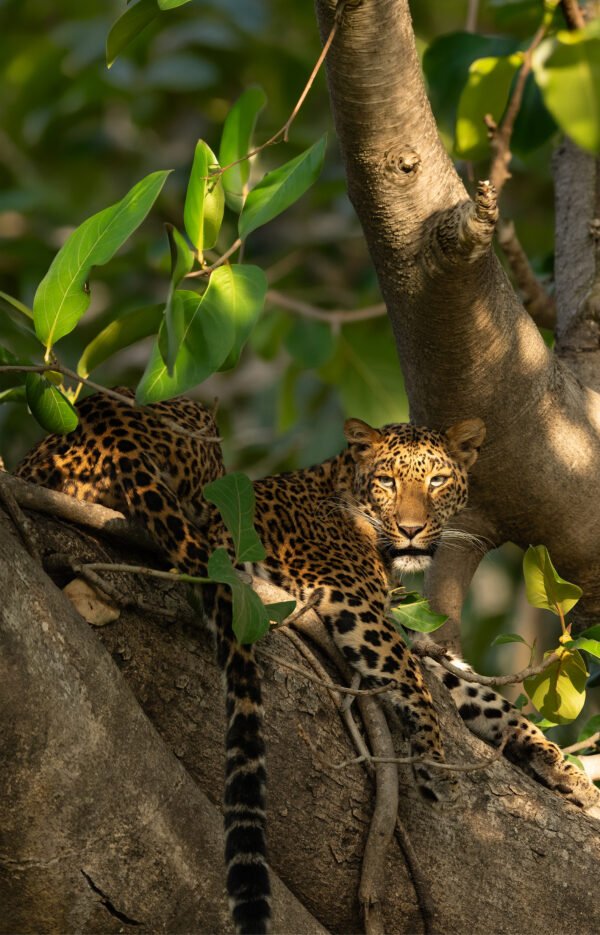
The first is elephants. Rajaji marks the northwestern limit of the Asian elephant’s entire range, and its herds move along the Ganga in numbers that turn the riverbanks into theatre. The second is leopards. While the crowds queue for tigers elsewhere, Rajaji has quietly become one of the most reliable places in India to see a leopard in the open, and the photographers who know have started coming here first. Declared a tiger reserve in 2015 and named for C. Rajagopalachari, free India’s last Governor-General, Rajaji is now also writing a third story: tigers are being restored to its western ranges, a project still unfolding drive by drive.
Flora
Sal dominates the hills, giving way to rohini, shisham and khair along the water, with bamboo brakes and open grasslands threading the valleys. The Shivaliks are young mountains, all ravines and seasonal streams called raus, and the forest follows their folds: dense on the slopes, open along the riverbeds. Those dry raus, wide ribbons of white sand and boulders, become the park’s stages. Everything crosses them, and everything leaves tracks.
Fauna
The leopard is Rajaji’s rising star, seen here with a frequency that veteran naturalists compare to Jawai’s. Around it moves one of north India’s great elephant populations, along with tigers in the recovering western ranges, sloth bears, striped hyenas, goral on the steep slopes, and sambar, chital and wild boar in the valleys. Otters work the Ganga’s channels, and the river itself divides the park into two personalities: the gentler eastern forests around Chilla, and the wilder, quieter west.
Birdlife
With over 300 recorded species, Rajaji sits on one of India’s great bird corridors, where Himalayan species meet the birds of the plains. Great hornbills beat across the canopy, khaleej pheasants pick through the understorey, and pied and crested kingfishers hold the streams. Winter brings wallcreepers and redstarts down from the high mountains, making the cold months a double season: leopards on the slopes, Himalayan birds along the raus.
Why Rajaji Is India’s Leopard Stage
- Open raus and sparse Shivalik slopes give leopards nowhere to melt away, producing clean, unobstructed sightings that dense-forest parks rarely allow
- Low vehicle numbers mean sightings unfold in silence, often with no other jeep in sight
- Winter light through the sal, from misty dawns to long golden afternoons, does half a photographer’s work
- Elephant herds on the Ganga add a second subject most leopard destinations cannot offer
Recent guests have returned with leopard sightings on every single drive of a six-safari itinerary. No wild place can promise that, but very few even make it possible.
The Safari
Rajaji rewards the traveller who arrives without a checklist. Drives here move through country that changes by the kilometre, ridgeline to riverbed to grassland, and the sightings follow the same rhythm: a herd of elephants crossing a rau at dawn, a leopard draped on a sal branch, goral picking down a slope you would swear was vertical. This is a big cat safari in India stripped of the queues and the pressure, guided by naturalists who read the Shivaliks like a first language. And for photographers, the park doubles as a proving ground: varied light, moving water and subjects from hornbills to elephants will test every piece of wildlife photography gear for India you own, and reward all of it.

 Apoorva Jadon