
Kaziranga
The wild floodplains of the Brahmaputra, where one-horned rhinos, tigers, and wild elephants move through grass taller than a jeep.
Safari Timings
Kaziranga lives by the river. The park closes through the monsoon, roughly May to October, when the Brahmaputra reclaims the floodplain, and reopens as the waters recede. The prime window runs from November to April: winter brings the migratory birds and soft light, while the weeks after the grass burns in early spring offer the year’s clearest sightlines. Morning and afternoon jeep safaris run daily in season, with exact timings set by the forest department; confirm the current schedule with your operator when booking.
Kaziranga National Park Safari
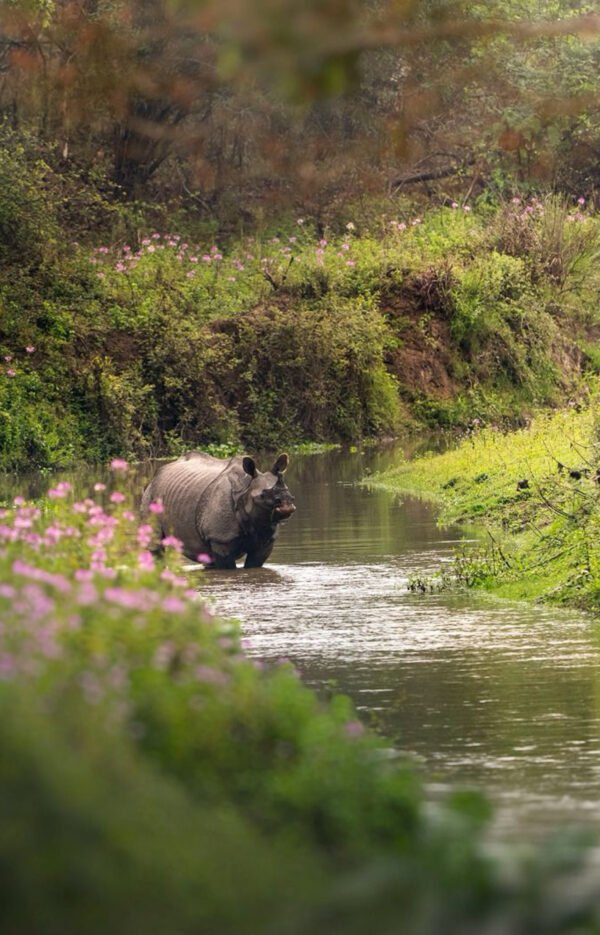
Everything about Kaziranga runs on a different scale. Spread across the floodplains of the Brahmaputra in Assam, this UNESCO World Heritage Site holds the largest population of the greater one-horned rhinoceros on earth, roughly two-thirds of all that remain. The river floods these grasslands every monsoon, and it is the flood that makes the place: silt renews the soil, the beels refill, and the tall grass grows higher than a jeep.
In central India you search for wildlife. In Kaziranga, it surrounds you. Rhinos graze in the open like it is the most ordinary thing in the world, wild elephants and water buffalo move through the wetlands, and the park quietly holds one of the highest tiger densities in India, hidden in grass tall enough to swallow them whole. A century ago, a handful of rhinos survived here. What stands today is one of the longest-running conservation successes anywhere on the planet.
Flora
Grass is the architecture of Kaziranga. Vast stretches of elephant grass and reed dominate the floodplain, broken by beels, the wetland lagoons left behind by the river, and patches of semi-evergreen forest along the higher ground. It is a landscape built by water, redrawn a little every year, and nothing about it behaves like the forests of central India.
Fauna
Kaziranga has its own Big Five: the one-horned rhino, the tiger, the Asian elephant, the wild water buffalo and the eastern swamp deer, and this is one of the only places on earth where a single morning can produce all of them. Leopards stalk the tall grass margins, hog deer scatter ahead of the jeeps, and otters work the beels. Then there is the resident that no other Indian safari can offer: a half-day away at the Hollongapara sanctuary near Jorhat lives the Hoolock Gibbon, the only ape found in India, swinging through the canopy in family groups that sing to each other at dawn.
Birdlife
Kaziranga is one of the great bird destinations of Asia, with well over 450 recorded species. Pelicans and adjutant storks crowd the wetlands, Pallas’s fish eagles patrol the beels, and the grasslands shelter the critically endangered Bengal florican. In winter the floodplain fills with migratory waterfowl until the water is more feather than surface.
The Safari
Drives here feel unlike anywhere else in India. The grass rises around the track like a living wall, and the safari becomes a study in openings: a rhino materializing thirty feet away, a herd of wild buffalo at a beel, the electric moment when the grass moves against the wind. Ranges across the park each carry a different character, from riverine forest to open wetland, and the Jorhat gibbon walk adds something no jeep can: an hour on foot beneath India’s only apes. For anyone whose idea of a wildlife tour of India ends at tiger country, Kaziranga is the correction, and the reason serious itineraries and guided wildlife photography tours keep turning northeast.



 Apoorva Jadon