
Borneo Wildlife Safari
A rainforest older than the Himalaya, where orangutans, proboscis monkeys, and hornbills line the Kinabatangan’s banks.
Safari Timings
The Kinabatangan is a year-round destination; this is equatorial rainforest, so expect heat, humidity and the honest possibility of rain in any month, with the drier stretch roughly from March to October offering the steadiest cruising. Pack light, breathable layers, serious insect repellent and rain protection for the cameras. Access is through Sandakan, with road transfers to Sukau handled within the itinerary, and connectivity thins as the forest thickens, which past guests consistently list as a feature. Fitness demands are gentle, boats and light trails only, making this the most accessible expedition in the international set.
The Safari
Days on the Kinabatangan run at three speeds. Dawn cruises catch the primates waking and the mist still on the water; dusk brings the proboscis troops to their sleeping trees and the elephants to drink; and the night cruise rewires your senses entirely, the forest reduced to eyeshine and sound. Between them sit guided jungle walks, wellies provided, and the Orang Sungai Gallery, where the river people’s generations of coexistence with this forest give the wildlife its human context. Everything runs on the expedition’s “observe, not intrude” principle, in partnership with local operators, because conscious wildlife travel here is not a slogan; on a river this intimate, it is the only way the wildlife stays.
Borneo: The Kinabatangan
In Sabah, on the Malaysian side of Borneo, the Kinabatangan River winds through rainforest that has stood for over a hundred million years, older than the Amazon, older than the Himalaya, old enough that evolution has had time to invent things found nowhere else. The river is the region’s great wildlife corridor, and along its banks lives Borneo’s own Big Five: the orangutan, the proboscis monkey, the estuarine crocodile, the rhinoceros hornbill and the Bornean pygmy elephant, the smallest elephant on earth.
There are no jeeps in this chapter of the collection. The safari is the river itself, run from the village of Sukau in small boats carrying six or seven guests at most, at dawn, at dusk and after dark. And the Kinabatangan tells an honest conservation story too: the forest along its banks is a lifeline threading through a changed landscape, which is exactly why the wildlife concentrates here, and exactly why travelling it responsibly matters.
Flora
This is lowland rainforest in its ancient form: towering dipterocarps, strangler figs, riverine forest hung with epiphytes, and oxbow lakes the river left behind as it changed its mind over centuries. The fig trees are the economy of the whole system; when one fruits, everything comes, from hornbills to orangutans, and a fruiting fig beside the river is the best appointment in Borneo.
Fauna
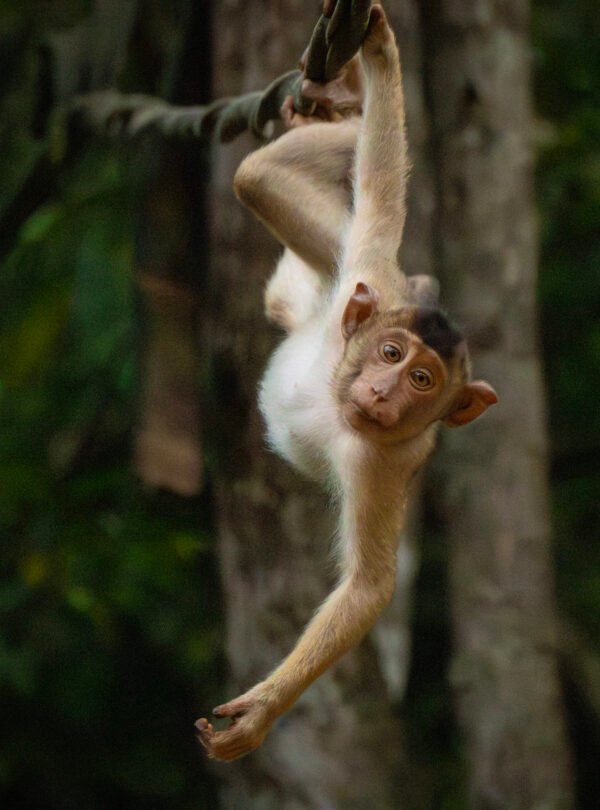
The orangutan needs no introduction, and the Kinabatangan is one of the most reliable places on earth to see one truly wild, building its evening nest high over the water. The proboscis monkey, found only on Borneo, gathers in riverside troops every evening, all improbable noses and crashing leaps. Pygmy elephants move along the banks in herds when the river calls them, estuarine crocodiles hold the water itself, and the supporting cast runs deep: silvered langurs, long-tailed macaques, and, for the night cruises, civets, slow lorises and the chance of a leopard cat in the spotlight’s edge.
Birdlife
The Kinabatangan is hornbill country without rival; the rhinoceros hornbill, casque glowing like lacquered fire, is the region’s crown, and multiple hornbill species can cross the river in a single cruise. The rare storm’s stork holds its global stronghold along these banks, stork-billed kingfishers flash between perches, broadbills and pittas colour the forest edge, and at Gomantong the sky itself becomes the show, as raptors gather for the evening bat flight.
The Bat Exodus at Gomantong
- Gomantong is one of Southeast Asia’s great cave systems, its chambers rising like a cathedral out of the forest
- At dusk, the cave exhales: hundreds of thousands of bats spiral into the evening sky in ribbons that bend and re-form like smoke
- The hunters know the schedule, and bat hawks and other raptors strike the columns mid-air, one of the most dramatic predator spectacles in Asia
- Timed as the expedition’s closing act, it turns the final evening into the story guests tell first when they get home



 Apoorva Jadon